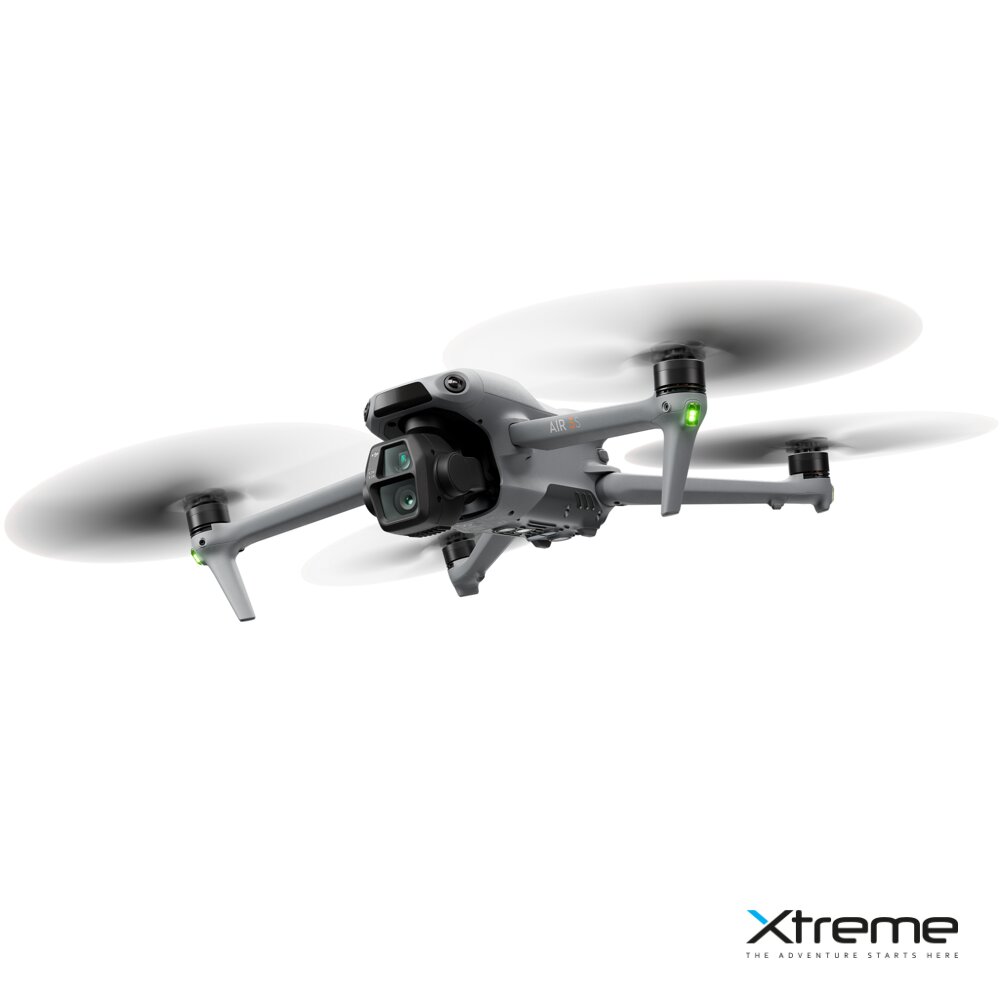
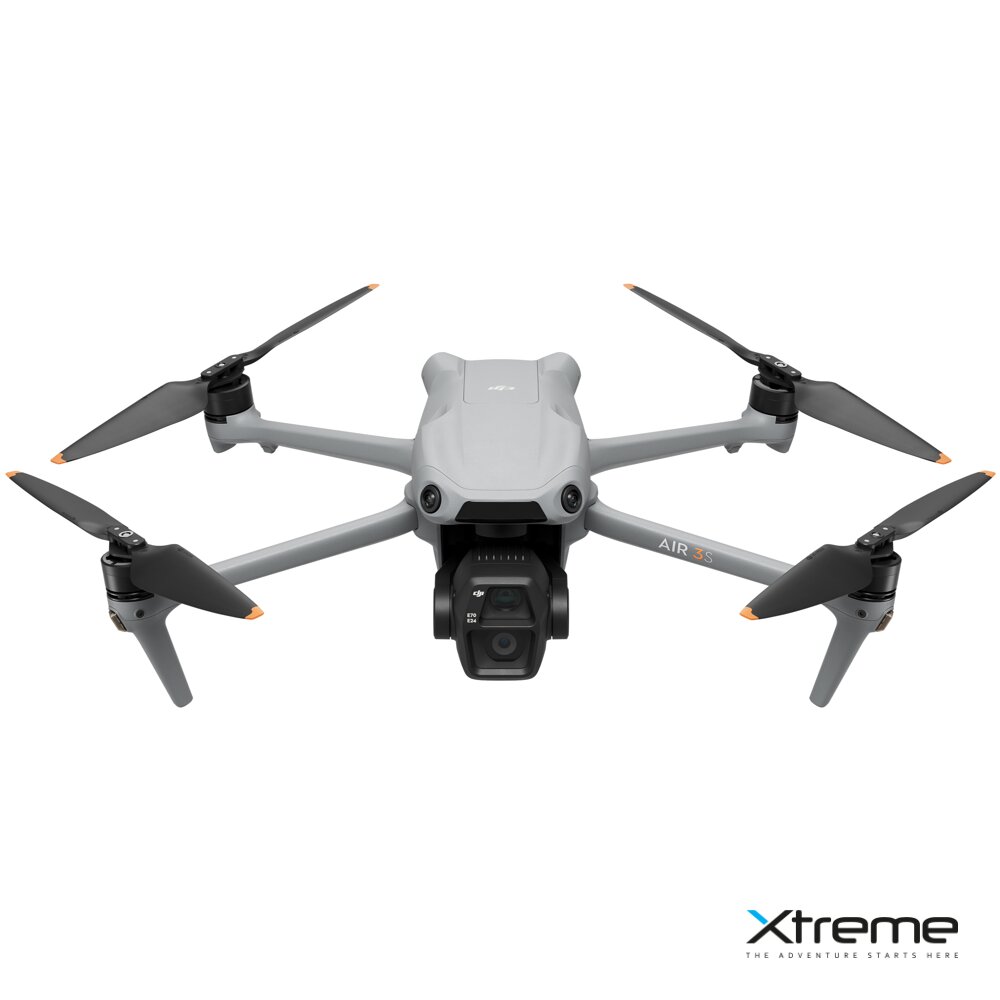
The DJI Air 3S is the latest dual-camera drone that packs a host of advanced technologies. With a 1-inch CMOS sensor and a 70mm medium telephoto lens, it can capture stunning detail with a dynamic range of up to 14 EV. [1]. Both cameras support Free Panorama, which allows for flexible shot selection. Also new is Night Composition[2] with omnidirectional obstacle detection, along with the next-generation Smart RTH function, which increases safety when shooting at night. The DJI Air 3S comes standard with 42GB of built-in memory, allowing you to start recording immediately without having to deal with microSD cards. The drone offers up to 45 minutes[3] of flight time and video transmission up to 10 km away.[4]

The DJI Air 3S features a dual camera system that includes a main camera with a 1-inch CMOS sensor and a medium telephoto lens with a 1/1.3-inch CMOS sensor. The cameras support the same video specifications and color modes. This ensures visually consistent footage, making post-production much easier.
Main wide-angle camera with 1″ CMOS sensor:
Pixel size 3.2 μm [5]
24mm format equivalent
50 MP
Aperture f/1.8
The latest HDR video mode offers up to 14 stops of dynamic range [1], allowing you to capture cinematic footage in high-contrast scenes, such as details in cloud textures or other elements during sunrise and sunset.
Improved resolution and frame rates bring a vivid perspective to cultural or sporting events and open up exciting possibilities in post-production.
Even in regular color mode, the DJI Air 3S can record 10-bit video with H.265 encoding, which ensures smoother color rendition and greater flexibility in post-production, while the maximum ISO value has been increased to 12,800. In D-Log M and HLG color modes, the maximum ISO value is increased to 3,200, allowing for greater clarity and more detail in nighttime urban scenes.
Medium telephoto lens with 1/1.3″ CMOS sensor:
Pixel size 2.4 μm [5]
70mm format equivalent
48 MP
Aperture f/2.8
When photographing vehicle details against the sunset, the medium telephoto lens offers a dynamic range of up to 14 EV [1], vividly capturing the rich, saturated colors of the setting sun.
When shooting 4K/120fps slow-motion videos while skiing, the medium telephoto lens can record high-quality videos that are slowed down to show the skier's skills and even the most subtle movements.
The DJI Air 3S medium telephoto lens also supports 10-bit video recording in regular color mode with H.265 encoding, providing subtle colors and greater flexibility in post-production. When the 10-bit D-Log M mode is activated, the camera captures richer color details and beautifully renders bright city lights as night falls.


Free Panorama mode allows you to create seamless panoramic shots by stitching multiple shots of a hand-held object or area. The wide-angle camera provides a wider field of view (FOV), which increases the efficiency of taking panoramic photos. The medium telephoto lens significantly reduces image distortion, allowing you to create expansive shots with a wide perspective from a few shots and rich details due to its focal length. Free Panorama is supported by both DJI Air 3S cameras.
The DJI Air 3S also supports user-favorite features like 2.7K vertical shooting, MasterShots, QuickShots, Hyperlapse, and more, making it a comprehensive and creative tool in one compact drone.

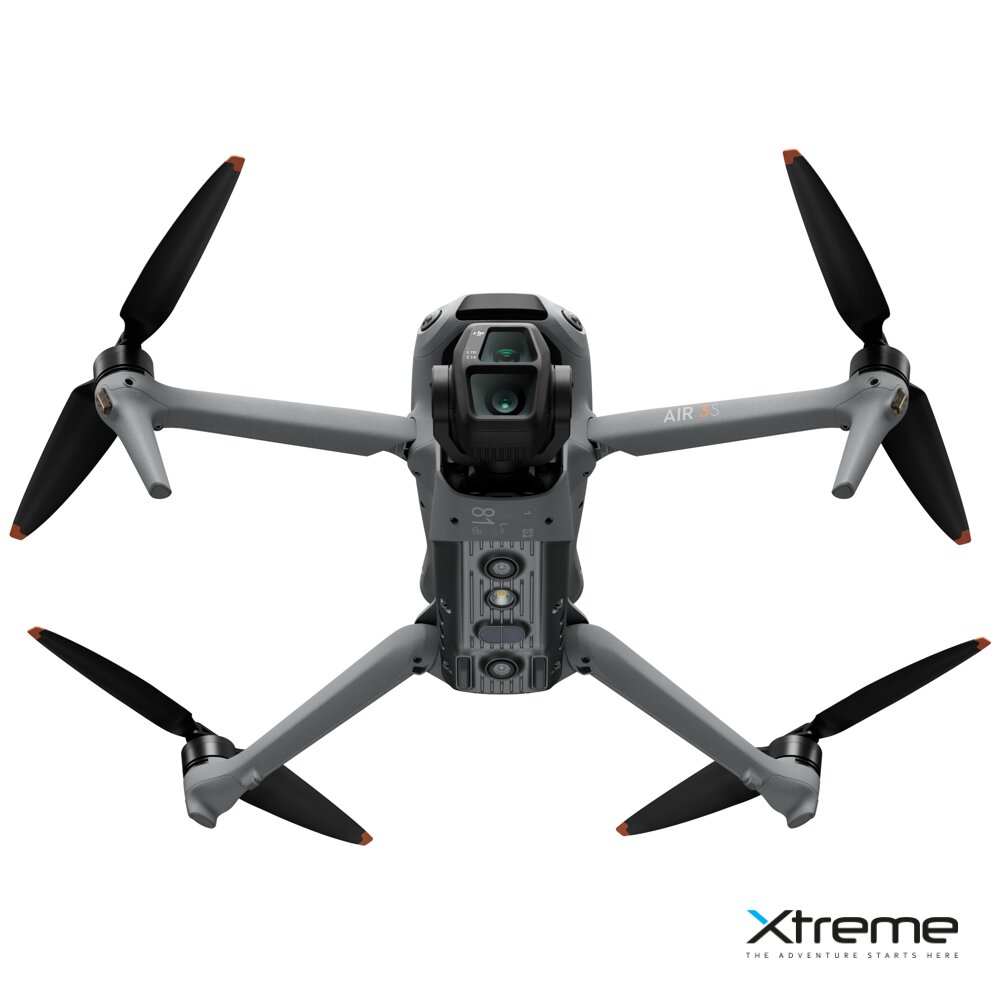
The DJI Air 3S is equipped with an Advanced Pilot Assistance System (APAS) and is the first drone from DJI to feature a forward-facing LiDAR. The drone is also equipped with bottom infrared sensors based on Time-of-Flight (ToF) technology and six visual sensors (two in the front, two in the rear and two on the bottom). This system enables omnidirectional obstacle recognition, which is especially useful when flying at night. Thanks to this feature, the drone automatically detects and avoids obstacles such as buildings during flight and return routes.

With real-time visual positioning technology and custom map construction, the DJI Air 3S remembers flight paths when there is sufficient lighting, ensuring a safe return home even when taking off from locations without satellite signals. [7]
With forward-facing LiDAR, the DJI Air 3S can detect obstacles such as tall buildings and safely fly upwards around them [7], even in low-light conditions, ensuring a safer return, especially at night.
The visual assistant in the DJI Air 3S drone provides a comprehensive view not only forward and backward, but also to the sides and downwards, which significantly improves the drone's orientation in space and increases your control during flight.
The drone also supports Waypoint Flight and Cruise Control features, which allow you to plan flight paths and camera actions in advance, allowing you to maintain a stable flight path without the need for manual intervention.
The DJI Air 3S features ActiveTrack 360°, which continuously tracks and keeps your subject in the frame. It automatically adjusts the flight path according to surrounding conditions and adjusts the framing to keep your subject in focus, ensuring precise and smooth shots.
Once tracking begins, the DJI Air 3S can keep the subject in the frame even if the lower part of its body is partially covered by bushes or if it is standing on a bridge.
The feature keeps the subject in focus even when you're flying manually or the subject moves off-center.
DJI O4 FHD’s OcuSync technology is designed for video transmission, and the Air 3S transmits 10-bit 1080p/60fps video at distances of up to 10 km. [4] Live transmission is reliably smooth and clear, with ultra-fast control response for a better flight experience.
The DJI Cellular Dongle 2 [8] can be inserted directly into the DJI Air 3S without the need for additional accessories. In the event of an obstacle to the O4 signal or interference, you can rely on a mobile 4G connection for stable video transmission and drone control.
Ability to send files from Air 3S to your smartphone even when the drone is powered off. [9] Transfers to your computer can be done even when the drone is powered off – simply connect Air 3S with a compatible USB cable.

| Parameter | Value |
|---|---|
| Takeoff Weight | 724 g |
| Dimensions | Folded (without propellers): 214.19×100.63×89.17 mm (L×W×H) Unfolded (without propellers): 266.11×325.47×106.00 mm (L×W×H) |
| Max Ascent Speed | 10 m/s |
| Max Descent Speed | 10 m/s |
| Max Horizontal Speed | At sea level, windless: 21 m/s* At sea level, with 6 m/s tailwind (flying with the wind): 27 m/s* 19 m/s in the EU region |
| Max Takeoff Altitude | 6000 m |
| Max Flight Time | 45 minutes |
| Max Hovering Time | 41 minutes |
| Max Flight Distance | 32 km |
| Max Wind Speed Resistance | 12 m/s |
| Max Pitch Angle | 36° |
| Operating Temperature | -10° to 40° C (14° to 104° F) |
| Global Navigation Satellite System | GPS + Galileo + BeiDou |
| Hovering Accuracy Range | Vertical: ±0.1 m (vision positioning) / ±0.5 m (satellite positioning) Horizontal: ±0.3 m (vision positioning) / ±0.5 m (satellite positioning) |
| Internal Storage | 42 GB |
| Class | C1 (EU) |
| Parameter | Value |
|---|---|
| Image Sensor | Wide-Angle Camera: 1-inch CMOS, 50MP Effective Pixels Medium Tele Camera: 1/1.3-inch CMOS, 48MP Effective Pixels |
| Lens | Wide-Angle Camera: FOV 84°, Format Equivalent 24 mm, Aperture f/1.8, Focus 0.5 m to ∞ Medium Tele Camera: FOV 35°, Format Equivalent 70 mm, Aperture f/2.8, Focus 3 m to ∞ |
| ISO Range | Video – Normal: 100-12800 (Normal), 100-3200 (D-Log M), 100-3200 (HLG) Video – Slow Motion: 100-6400 (Normal), 100-3200 (D-Log M), 100-3200 (HLG) Photo: 100-6400 (12 MP), 100-3200 (48 and 50 MP) |
| Shutter Speed | Wide-Angle Camera: 12MP – 1/8000-2 s (2.5-8 s for simulated long exposure), 50MP – 1/8000-2 s Medium Tele Camera: 12MP – 1/16000-2 s (2.5-8 s for simulated long exposure), 48MP – 1/8000-2 s |
| Max Image Size | Wide-Angle Camera: 8192×6144 Medium Tele Camera: 8064×6048 |
| Still Photography Modes | Wide-Angle Camera: Single Shot (12/50 MP); Burst 12MP (3/5/7), 50MP (3/5); AEB 12MP (3/5/7), 50MP (3/5) at 0.7 EV step; Timed 12MP (2-60 s), 50MP (5-60 s) Medium Tele Camera: Single Shot (12/48 MP); Burst 12MP (3/5/7), 48MP (3/5); AEB 12MP (3/5/7), 48MP (3/5) at 0.7 EV step; Timed 12MP (2-60 s), 48MP (5-60 s) |
| Photo Format | JPEG/DNG (RAW) |
| Video Resolution | Wide-Angle/Medium Tele Camera – H.264/H.265 4K: 3840×2160@24/25/30/48/50/60/120fps<br>FHD: 1920×1080@24/25/30/48/50/60/120/240*fps 2.7K Vertical Shooting: 1512×2688@24/25/30/48/50/60fps Recording frame rates — corresponding video plays as slow motion. Slow-motion and 4K recordings only support H.265. |
| Video Format | MP4 (MPEG-4 AVC/H.264, HEVC/H.265) |
| Max Video Bitrate | H.264/H.265: 130 Mbps* |
| Supported File System | exFAT |
| Color Mode and Sampling Method | Normal (FHD/2.7K): 8-bit 4:2:0 (H.264) Normal (FHD/2.7K): 10-bit 4:2:0 (H.265) HLG/D-Log M (FHD/2.7K): 10-bit 4:2:0 (H.264/H.265) Normal/HLG/D-Log M (4K): 10-bit 4:2:0 (H.265) |
| Digital Zoom | Wide-Angle Camera: 1-2.9x / Medium Tele Camera: 3-9x |
| Parameter | Value |
|---|---|
| Stabilization | 3-axis mechanical gimbal (tilt, roll, pan) |
| Mechanical Range | Tilt: -135° to 70° / Roll: -50° to 50° / Pan: -27° to 27° |
| Controllable Range | Tilt: -90° to 60° / Pan: -5° to 5° |
| Max Control Speed (tilt) | 100°/s |
| Angular Vibration Range | ±0.0037° |
| Parameter | Value |
|---|---|
| Sensing Type | Omnidirectional binocular vision system, supplemented with forward-facing LiDAR and a bottom infrared sensor |
| Forward | Measurement Range: 0.5-18 m / Detection Range: 0.5-200 m / Effective Speed: ≤15 m/s / FOV: Horizontal 90°, Vertical 72° |
| Backward | Measurement Range: 0.5-18 m / Effective Speed: ≤14 m/s / FOV: Horizontal 90°, Vertical 72° |
| Lateral | Measurement Range: 0.5-30 m / Effective Speed: ≤14 m/s / FOV: Horizontal 90°, Vertical 72° |
| Upward | Measurement Range: 0.5-18 m / Effective Speed: ≤6 m/s / FOV: Front/Back 72°, Left/Right 90° |
| Downward | Measurement Range: 0.3-14 m / Effective Speed: ≤6 m/s / FOV: Front/Back 106°, Left/Right 90° |
| Operating Environment | Forward/Backward/Lateral/Upward: surfaces with discernible patterns and adequate lighting (lux >1) Downward: same + diffuse reflectivity >20% (walls, trees, people), lighting (lux >1) |
| 3D Infrared Sensor | Forward LiDAR: nighttime range 0.5-25 m (reflectivity >10%), FOV: Up/Down 60°, Left/Right 60° Downward IR: range 0.3-8 m (reflectivity >10%), FOV: Front/Back 60°, Left/Right 60° |
| Parameter | Value |
|---|---|
| Video Transmission System | O4 |
| Live View Quality | Remote Controller: 1080p/30fps, 1080p/60fps |
| Operating Frequency | 2.4000–2.4835 GHz / 5.170–5.250 GHz / 5.725–5.850 GHz |
| Transmitter Power (EIRP) | 2.4 GHz: <33 dBm (FCC), <20 dBm (CE/SRRC/MIC) 5.1 GHz: <23 dBm (CE) 5.8 GHz: <33 dBm (FCC), <30 dBm (SRRC), <14 dBm (CE) |
| Max Transmission Distance (unobstructed, no interference) | FCC: 20 km / CE: 10 km / SRRC: 10 km / MIC: 10 km |
| Max Transmission Distance (unobstructed, with interference) | Strong (urban): approx. 1.5-4 km Medium (suburban): approx. 4-10 km Low (suburb/seaside): approx. 10-20 km |
| Max Transmission Distance (obstructed, with interference) | Low interference, buildings: approx. 0-0.5 km Low interference, trees: approx. 0.5-3 km |
| Max Download Speed | O4: 10 MB/s (with RC-N3), 10 MB/s (with RC 2) Wi-Fi 5: 30 MB/s* |
| Lowest Latency | Aircraft + Remote Controller: approx. 120 ms |
| Antenna | 6 antennas, 2T4R |
| Parameter | Value |
|---|---|
| Protocol | 802.11 a/b/g/n/ac |
| Operating Frequency | 2.400–2.4835 GHz / 5.725–5.850 GHz |
| Transmitter Power (EIRP) | 2.4 GHz: <20 dBm (FCC/CE/SRRC/MIC) 5.8 GHz: <20 dBm (FCC/SRRC), <14 dBm (CE) |
| Parameter | Value |
|---|---|
| Protocol | Bluetooth 5.2 |
| Operating Frequency | 2.400–2.4835 GHz |
| Transmitter Power (EIRP) | <10 dBm |
| Parameter | Value |
|---|---|
| Capacity | 4276 mAh |
| Weight | Approx. 247 g |
| Nominal Voltage | 14.6 V |
| Max Charging Voltage | 17.2 V |
| Type | Li-ion 4S |
| Energy | 62.5 Wh |
| Charging Temperature | 5° to 40° C (41° to 104° F) |
| Charging Time | Approx. 80 minutes (with DJI 65W Portable Charger) Approx. 60 minutes (with DJI 100W USB-C Power Adapter and Battery Charging Hub) |
| Parameter | Value |
|---|---|
| Input | DJI 65W Portable Charger: 100-240 V (AC), 50-60 Hz, 2 A DJI 100W USB-C Power Adapter: 100-240 V (AC), 50-60 Hz, 2.5 A |
| Output | DJI 65W Portable Charger: USB-C: 5V/5A, 9V/5A, 12V/5A, 15V/4.3A, 20V/3.25A, 5-20V/3.25A USB-A: 5V/2A DJI 100W USB-C Power Adapter: Max 100 W total (when both ports are used, max output of one port is 82 W; power is dynamically allocated) |
| Rated Power | DJI 65W Portable Charger: 65 W DJI 100W USB-C Power Adapter: 100 W |
| Parameter | Value |
|---|---|
| Input | USB-C: 5-20 V, max 5 A |
| Output (power accumulation) | Battery Port: 12-17.2 V, 3.5 A |
| Output (charging) | Battery Port: 12-17.2 V, max 5 A |
| Output (USB) | USB-C: 5V/3A, 9V/5A, 12V/5A, 15V/5A, 20V/4.1A |
| Charging Type | Three batteries charged in sequence |
| Compatibility | DJI Air 3 Intelligent Flight Battery / DJI Air 3S Intelligent Flight Battery |
| Parameter | Value |
|---|---|
| Input | Car Power Input: 12.7-16 V, 6.5 A, rated voltage 14 V (DC) |
| Output | USB-C: 5V/5A, 9V/5A, 12V/5A, 15V/4.3A, 20V/3.25A, 5-20V/3.25A USB-A: 5V/2A |
| Rated Power | 65 W |
| Charging Temperature | 5° to 40° C (41° to 104° F) |
| Parameter | Value |
|---|---|
| Recommended microSD Cards | Lexar 1066x (64GB–512GB, V30 U3 A2 microSDXC) Kingston Canvas GO! Plus (64GB–512GB, V30 U3 A2 microSDXC) |
| Parameter | Value |
|---|---|
| Max Operating Time | Without charging mobile device: 3.5 hours / When charging mobile device: 1.5 hours |
| Max Supported Mobile Device Size | 180×86×10 mm (L×W×H) |
| Operating Temperature | -10° to 40° C (14° to 104° F) |
| Charging Temperature | 5° to 40° C (41° to 104° F) |
| Charging Time | 2 hours |
| Charging Type | 5V/2A charger recommended |
| Battery Capacity | 9.36 Wh (3.6 V, 2600 mAh) |
| Weight | Approx. 320 g |
| Dimensions | 104.2×150×45.2 mm (L×W×H) |
| Supported Mobile Device Port Type | Lightning, USB-C, Micro-USB (Micro-USB requires separately sold DJI RC-N Series RC Cable) |
| Video Transmission Operating Frequency | 2.4000–2.4835 GHz / 5.170–5.250 GHz / 5.725–5.850 GHz |
| Video Transmission Transmitter Power (EIRP) | 2.4 GHz: <33 dBm (FCC), <20 dBm (CE/SRRC/MIC) 5.1 GHz: <23 dBm (CE) 5.8 GHz: <33 dBm (FCC), <14 dBm (CE), <30 dBm (SRRC) |
Väčší a stabilnejší dron s lepšou kamerou. Pribudne len online test a Remote ID. Typicky DJI Air 3S, Mavic 3 Classic, Avata 2
We send packages
on the day of the order
DJI warranty
service
Store
in Bratislava
Visa, Mastercard, ApplePay
Express Courier, Courier,
Pick-Up Point